Givan: A new way forward for integrated education
Date published:
Education Minister Paul Givan has today published a Department of Education Position Paper on Integrated Education, to provide clarification on the legal framework governing Integrated Education and outlining measures designed to support schools considering transformation to integrated status.
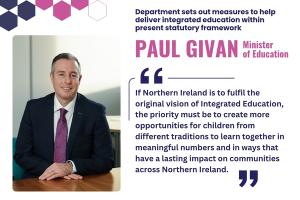
The Position Paper responds to the recent court judgment and transformation applications which have highlighted important issues about how the law relating to integrated education should be interpreted and applied. It also sets out a new approach to the collection of information for assessing ‘reasonable numbers of Protestant and Roman Catholic children’ to better support schools seeking to transform to integrated status.
Paul Givan said:
"Integrated education was established to bring together children from Protestant and Roman Catholic backgrounds in a society historically marked by division. The requirement for reasonable numbers of pupils from both traditions is a core element of integrated education and a statutory requirement embedded in legislation.
"The reality is that many schools seeking to transform face significant challenges in demonstrating how they will achieve and sustain meaningful representation from both communities. In many cases, demographic factors and historic patterns of enrolment make this a difficult hurdle to overcome."
The position paper highlights evidence which shows that many schools which have transformed have faced significant challenges in achieving and sustaining balanced representation from both communities over time. The Department notes that 31 of 33 transformed schools had a minority community population of less than 25% in 2025/26.
To help address these challenges, the Department has introduced the Integrated Education Support Programme, a structured three-year programme designed to help schools develop the relationships, practices and community engagement needed to attract and sustain enrolments from both traditions before applying for transformation.
Paul Givan continued:
"We are shifting the focus towards supporting schools to build integration before formal transformation takes place. Real integration is achieved through sustained engagement, community confidence and increasing participation from both traditions over time.
"Transformation should recognise and formalise progress that has already been achieved, rather than begin it. Lasting integration is achieved through genuine cultural and demographic change, not simply through a change in school designation alone."
The Department also intends to revise arrangements for gathering information used to assess community background. Proposals will be developed to introduce a community background category alongside existing information, allowing schools and the Department to better assess progress towards achieving meaningful integration.
In conclusion the Minister said:
"If Northern Ireland is to fulfil the original vision of Integrated Education, the priority must be to create more opportunities for children from different traditions to learn together in meaningful numbers and in ways that have a lasting impact on communities across Northern Ireland.”
Further information is available in the Position Paper at: https://www.education-ni.gov.uk/publications/written-ministerial-statement-position-paper-integrated-education
Notes to editors:
1. For more news from the Department of Education, you can follow us on our social media channels:
- X @Education_NI(external link opens in a new window / tab)
- Facebook Department of Education NI(external link opens in a new window / tab)
- Instagram de_northern_ireland(external link opens in a new window / tab)
- LinkedIn Department of Education(external link opens in a new window / tab)
2. Media enquiries to the Department of Education Press Office at Press.Office@education-ni.gov.uk.
3. The Executive Information Service operates an out of hours service for media enquiries only between 1800hrs and 0800hrs Monday to Friday and at weekends and public holidays. The duty press officer can be contacted on 028 9037 8110.