Givan: Literacy and Numeracy outcomes demonstrate clear need for reform
Date published:
Education Minister Paul Givan today welcomed the publication of Northern Ireland’s first literacy and numeracy assessment results in more than 20 years.
The results provide a clear picture of how children and young people are performing and highlights the need for a renewed collective focus on raising standards.
The assessments, conducted by CCEA, involved more than 12,000 pupils in Years 4, 7 and 10 across a representative sample of 358 schools and provides a robust baseline against which future progress can be measured. For the first time, pupils across Northern Ireland in these year groups completed the same assessments under the same conditions, with all tests marked externally.
While the results show many pupils are performing well, they also reveal significant challenges that cannot be ignored. Almost three in ten pupils are not reaching the expected standard in literacy and numeracy by the end of primary school. By the end of Key Stage 3, almost one-third of pupils are not achieving the expected level in numeracy.
Commenting on the results, Paul Givan said:
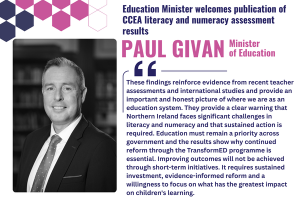
“These findings reinforce evidence from recent teacher assessments and international studies and provide an important and honest picture of where we are as an education system. They provide a clear warning that Northern Ireland faces significant challenges in literacy and numeracy and that sustained action is required.
“The results show clearly that too many children are leaving primary school without the literacy and numeracy skills they need to thrive. Literacy and numeracy are not simply two subjects among many. They are the foundation upon which all learning is built and the gateway to future success in education, employment and life. The most successful education systems in the world maintain a relentless focus on these foundations. We must do the same.
“Education must remain a priority across government and the results show why continued reform through the TransformED programme is essential. Improving outcomes will not be achieved through short-term initiatives. It requires sustained investment, evidence-informed reform and a willingness to focus on what has the greatest impact on children's learning.”
The assessments also expose a stark and widening disadvantage gap. More than 40% of pupils entitled to Free School Meals are below the expected standard in literacy and numeracy by the end of primary school, while over half are below the expected standard in numeracy by the end of Key Stage 3.
Paul Givan stressed that improving literacy and numeracy benefits far more than academic attainment. He continued:
"Strong literacy and numeracy underpin educational success, employability, attendance, behaviour and inclusion. They are among the most powerful tools we have to improve outcomes for disadvantaged children and young people with special educational needs.
“When children can access learning successfully, they are more likely to engage in school, attend regularly and develop the confidence they need to succeed.”
The Minister concluded with a call for collective action:
"Our teachers, school leaders and support staff work tirelessly in increasingly challenging circumstances. I am asking everyone to unite behind a simple ambition: that every child leaves school literate, numerate and ready to thrive. If we are serious about improving opportunity, social mobility and economic prosperity, then literacy and numeracy must be our shared priority. The evidence is clear. The challenge is real. The time to act is now."
The publication of the 2025/26 statutory end of Key Stage assessment outcomes can be found at: https://ccea.org.uk/statutory-assessment-reports-and-statistics
Further information is available in the Written Ministerial Statement at: https://www.education-ni.gov.uk/publications/written-ministerial-statement-publication-key-stage-assessment-outcomes
Notes to editors:
1.
| Skill | Key Stage | Expected Level | % below expected Level | % at or above expected Level | % above expected Level |
| English Literacy | Key Stage 1 | Level 2 | 20.4% | 79.6% | 21.5% |
| Key Stage 2 | Level 4 | 27.0% | 73.0% | 20.0% | |
| Key Stage 3 | Level 5 | 27.9% | 72.1% | 29.2% | |
| Numeracy | Key Stage 1 | Level 2 | 22.0% | 78.0% | 28.1% |
| Key Stage 2 | Level 4 | 26.9% | 73.1% | 28.5% | |
| Key Stage 3 | Level 5 | 32.2% | 67.8% | 23.0% |
2. Media enquiries to the Department of Education Press Office at Press.Office@education-ni.gov.uk
3. For more news from the Department of Education, you can follow us on our social media channels:
- X @Education_NI
- Facebook Department of Education NI
- Instagram de_northern_ireland
- LinkedIN Department of Education
4. The Executive Information Service operates an out-of-hours service for media enquiries only between 1800hrs and 0800hrs Monday to Friday and at weekends and public holidays. The duty press officer can be contacted on 028 9037 8110.