Givan: Parental choice to take priority under new Temporary Variation Proposals
Date published:
Education Minister, Paul Givan, has today announced plans to reform Northern Ireland’s school admissions system, placing parental preference at the heart of decision-making.
Proposals to reshape the operation of the Temporary Variation policy will allow schools to more easily increase their intakes where parental demand exists.
Announcing the reforms in a Written Ministerial Statement, Paul Givan said:
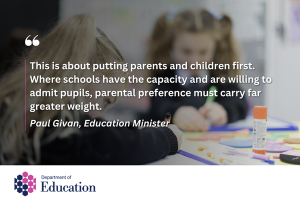
“This is about putting parents and children first. Where schools have the capacity and are willing to admit pupils, parental preference must carry far greater weight.
“For too long, we have seen situations where children could not attend the school their parents chose, even when there was space available. That is something that I have been determined to change.”
Northern Ireland has a strong tradition of parental preference across its diverse education sectors. However, the Minister acknowledged that for some families, particularly where popular schools are oversubscribed, existing policy has put too much weight on availability within a school sector, and not enough on the specific choices made by parents. He continued:
“The evidence is clear: parents choose schools, not sectors. They are focused on what they believe is best for their child, not on administrative categories. Our system must reflect that reality. Where demand exists for a particular school, we should be responding to that demand wherever possible.”
Subject to consultation, the proposals include:
- A presumption of approval for Temporary Variation requests in primary schools where capacity exists and schools can safely admit additional pupils
- A similar presumption for non-selective post-primary schools
- Continued case-by-case consideration for academically selective post-primary schools
- Greater flexibility for children already holding a school place to transfer to another school in line with parental wishes
Highlighting how the current arrangements can sometimes mask underlying issues, and limit access to high-performing schools while sustaining provision that lacks parental support, Paul Givan continued:
“This is not just a technical change to admissions. It is about creating an education system that listens to parents, reflects their choices and responds to the needs of children and families.
“Looking to the future, we are seeing a sustained decline in pupil numbers. That means increasing surplus capacity across our system. In that context, it is neither sustainable nor reasonable to ignore parental preferences where capacity exists.
“Enrolment patterns should tell us the truth about parental confidence in our schools. Where schools are attracting families, they should be able to grow. Where demand is persistently weak, that must be recognised and addressed.
“We must ensure that our school system reflects where parents actually want to send their children, not simply historic patterns or rigid rules.”
A full public consultation will be launched in September 2026, inviting views from parents, schools and stakeholders on how the new approach should be implemented.
Paul Givan concluded:
“I recognise that these changes must be carefully managed. There are important issues around sustainability, capacity and provision for children with additional needs.
“The consultation will focus on how we implement these changes in the best interests of all learners and I want parents, schools and stakeholders to play a central role in shaping the final policy.”
Further information is available in the Written Ministerial Statement, available at: https://www.education-ni.gov.uk/publications/written-ministerial-statement-temporary-variation-policy-review
Notes to editors:
1. The current Temporary Variation policy allows schools to admit additional named pupils where they are oversubscribed, subject to confirmation that they can safely accommodate them.
2. As of 24 June 2026, the Department has approved an additional 148 Primary 1 and 630 Year 8 places for the 2026/27 school year.
3. By 2033/34, overall school enrolment is projected to fall by 12.7%, including 20.4% at primary level and 9.5% at post-primary level.
4. The current TV policy can be found at Temporary Variation Circular 2026 03_3.pdf
5. For more news from the Department of Education, you can follow us on our social media channels:
- X @Education_NI
- Facebook Department of Education NI
- Instagram de_northern_ireland
- LinkedIn Department of Education
6. Media enquiries to the Department of Education Press Office at Press.Office@education-ni.gov.uk.
7. The Executive Information Service operates an out of hours service for media enquiries only between 1800hrs and 0800hrs Monday to Friday and at weekends and public holidays. The duty press officer can be contacted on 028 9037 8110.